How vacuum anchoring works
A vacuum cup does not suck. Atmospheric pressure pushes.
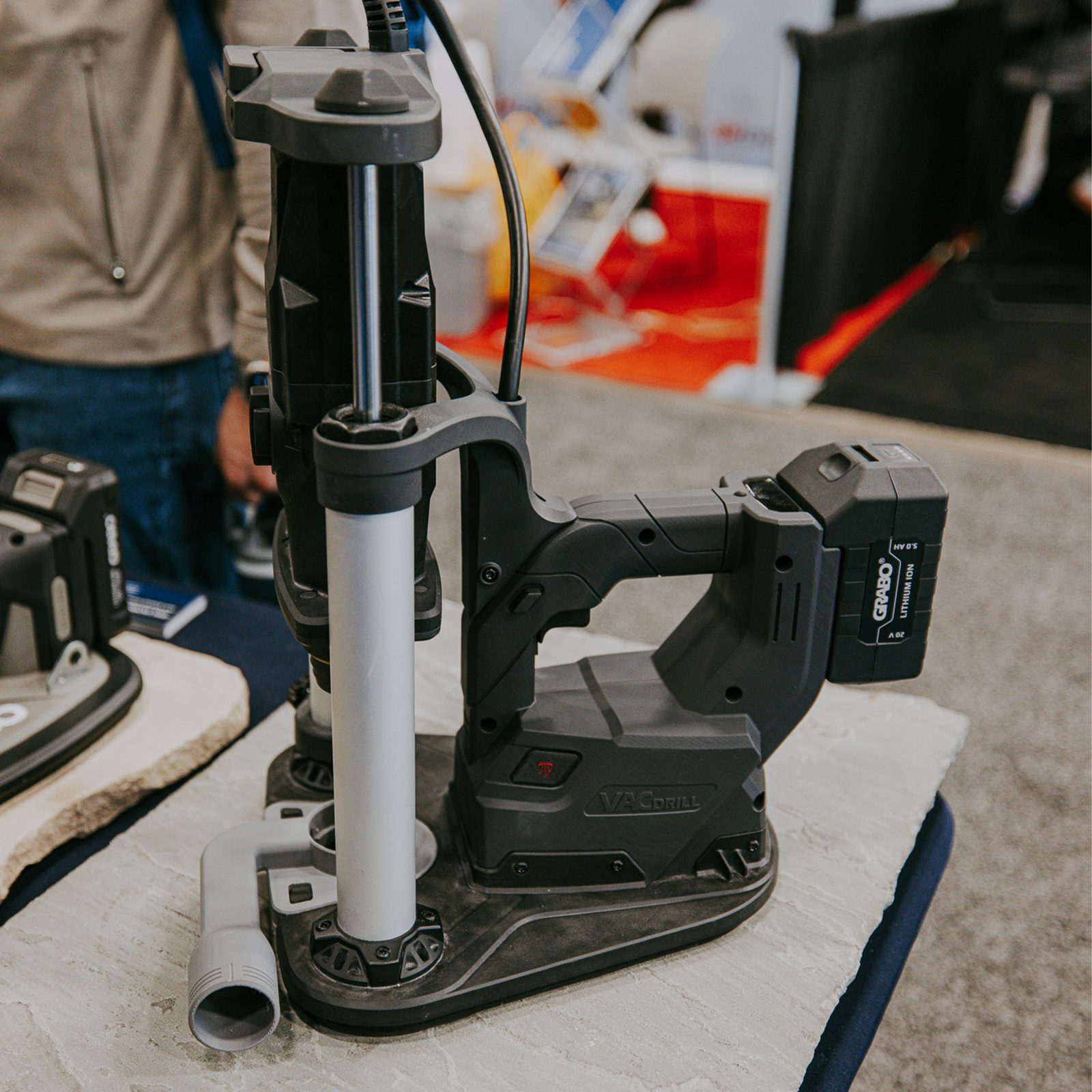
The pressure difference is the whole mechanism
A vacuum pad works by removing air from a sealed volume between the pad and the work surface. Once the pressure inside is lower than the pressure outside, the surrounding atmosphere presses the pad against the surface. Nothing pulls. The force you feel is the weight of the atmosphere.
Sea-level atmospheric pressure is roughly 1 bar. The VACDRILL works at about 0.8 bar of vacuum, meaning it removes most — but deliberately not all — of the air underneath. The force available is that pressure difference multiplied by the effective sealed area.
Why the number is quoted with conditions
GRABO quotes up to 45 kgf on non-porous surfaces at 0.8 bar. Both conditions are load-bearing. A pump can only hold a vacuum it can maintain: if air leaks in through the material or past the seal as fast as the pump removes it, the differential collapses and so does the holding force.
That is why the same tool feels rock-solid on polished stone and needs care on a dusty, open-pore block wall. The pump is not weaker; the surface is leakier.
Powered, not passive
A hand-pumped suction cup is a one-shot device: you create the vacuum once and hope it holds. A powered cup runs a pump continuously, so it actively replaces air that leaks in. This is what makes vacuum attachment viable on real construction surfaces rather than only on glass.
It also means the tool can tell you about its own grip, because the pump's behaviour reflects the quality of the seal.
What it has to resist
Anchoring a drill is harder than anchoring a lifter. A lifter mostly resists a steady load in one direction. A hammer drill generates a cyclic axial reaction, torque about the bit axis, and vibration that works at the seal. The base therefore has to hold not just the machine's weight but the reaction of the hammer mechanism, without walking or peeling at the edge.
Questions about this
Does a vacuum cup actually suck?
No. Removing air from beneath the pad lowers the pressure inside, and the surrounding atmosphere then presses the pad against the surface. The force you feel is atmospheric pressure pushing, not the cup pulling.
Why is holding force quoted only for non-porous surfaces?
Because a porous surface leaks air through the material itself. The pump cannot maintain the pressure difference, so the achievable holding force falls — sometimes to nothing.