The self-driving feed mechanism
The patent phrase is 'self-holding and self-driving'. The second half is the part people miss.
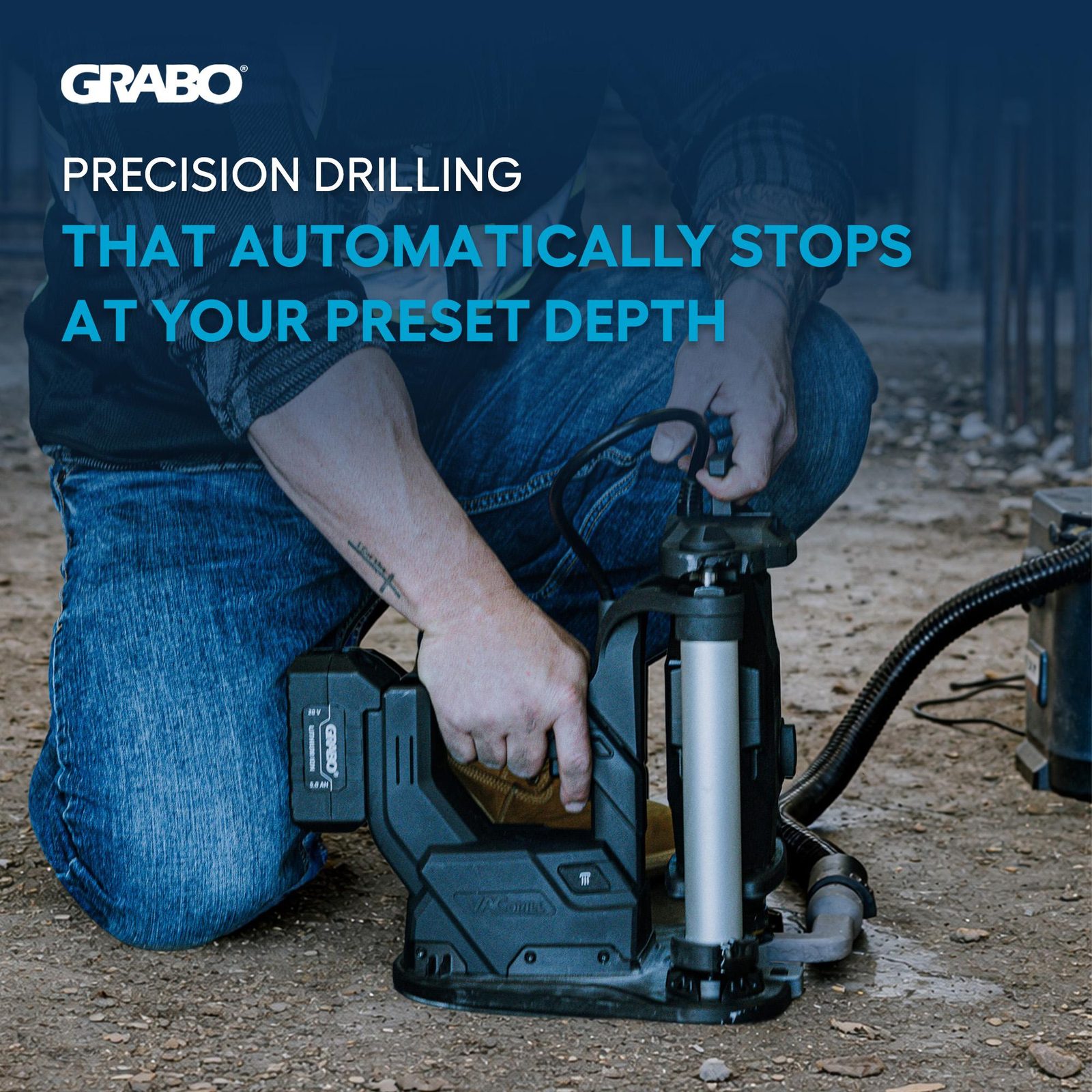
Feed force is a quality variable
Hand-fed drilling produces uneven feed. Push too hard and the bit binds, the hammer stalls and the hole goes oversize. Push too little and the bit polishes rather than cuts. Either way the axis wanders, because a human wrist is a poor bearing.
Mounting the hammer on a column converts an unstable freehand operation into a constrained one: the bit can only travel along a single axis.
Perpendicularity comes for free
Once the base is anchored flat to the surface, the column is normal to that surface. Every hole is therefore perpendicular without the operator judging it by eye. For anchor performance this matters — a hole drilled off-axis reduces the effective embedment and loads the anchor eccentrically.
Repeatability across a pattern
When you drill a pattern of fixings, the variable that ruins the set is inconsistency between holes. A machine-driven feed with a depth stop makes hole 20 identical to hole 1, which is what lets you torque a whole array to the same specification. See the depth sensor.
Questions about this
Does the operator still control the drilling?
Yes — you set the depth, choose the mode and monitor the hole. What you no longer supply is the feed force and the axis, which are the two things a human does least consistently.
Can I override the feed if the bit binds?
Always follow the tool's operating instructions. As a general rule, a bit that binds means you have hit something — usually aggregate or reinforcement — and the correct response is to stop and assess, not to increase force.