Jobsite Productivity: Cycle Time, Labour and Cost per Hole with VACDRILL
The price tag answers one question. Cost per installed, inspected, approved hole answers the only question the site cares about.
Cycle time: the stopwatch that matters
Model one hole as four steps: position, anchor, drill-to-stop, release. With a hand-held tool the steps are position, drill (with pumping to clear dust), blow/brush per approval, set anchor, manage dust. With VACDRILL the dust management and perpendicularity control are partly concurrent with the drilling step.
On repetitive M8–M12 anchor patterns in C25/30 concrete, field observations put a hand-held cycle at roughly 90–150 seconds per hole including cleaning, with wide variance for operator fatigue and overhead. A guided, anchored cycle is typically 60–100 seconds with tighter variance — the gain is consistency more than raw speed.
Consistency matters for scheduling: a gang that drills 120 holes per floor with a 60-second standard deviation cannot promise handover. A tighter distribution promises it with fewer buffers.
Labour: one person, two hands free
Conventional overhead or vertical drilling often ties up two people — one to drill, one to support, spot, or manage dust. A self-anchoring press returns the task to one person operating from a single position, freeing the second person for setting anchors, feeding material or preparing the next bay.
That is not headcount reduction for its own sake; it is utilisation. The second person moves from bracing the drill to advancing the job.
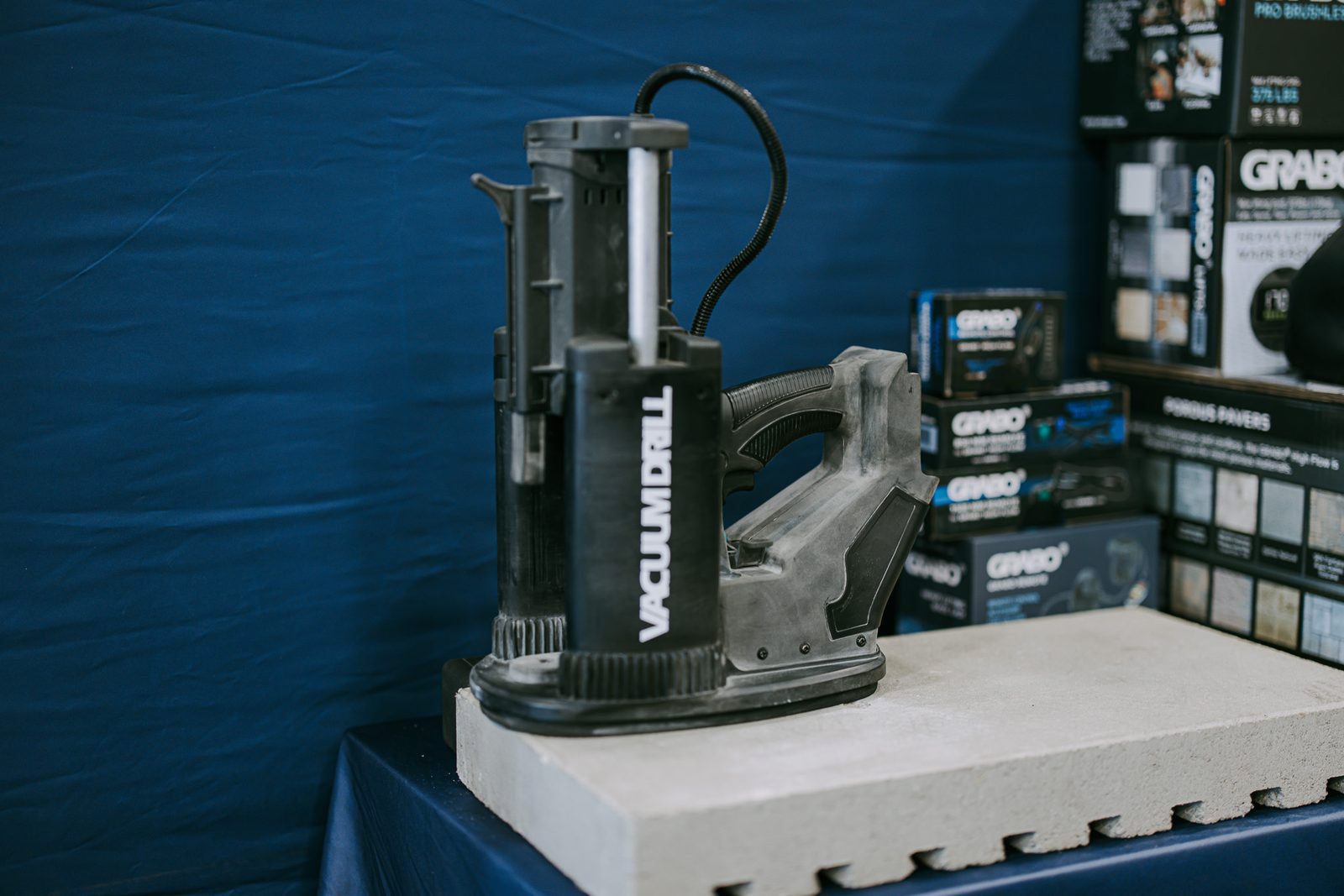
Transfer and setup are also labour. The VACDRILL unit moves as one machine — pad, column, hammer — not as a drill plus a separate jig. Position, seal, drill, release and carry is the logistics loop.
Rework, scrap and inspection risk
An out-of-tolerance hole is rarely repairable where it is. The cost is the lost anchor, the adjacent hole, the patch, and often a structural query. If 4% of hand-held holes are reworked versus 0.5% of guided holes, the effective cost per approved hole diverges well beyond the per-hole drill time.
Inspection amplifies the effect. A hole pattern that fails a pull test or an embedment check generates re-test labour and programme delay that no drill's purchase price captures. Predictable depth and perpendicularity reduce that tail risk.
Dust handling also carries a compliance cost. Capture at source with a sealed base reduces housekeeping, barrier time and the likelihood of a dust-related stop-work. That cost is real even when it is accounted on a different line.