Vacuum-Anchored Drilling vs Hand-Held Hammer Drilling: Holding Force, Accuracy and Fatigue
Conventional hammer drilling makes the operator the fixture. Vacuum-anchored drilling makes the wall the fixture.
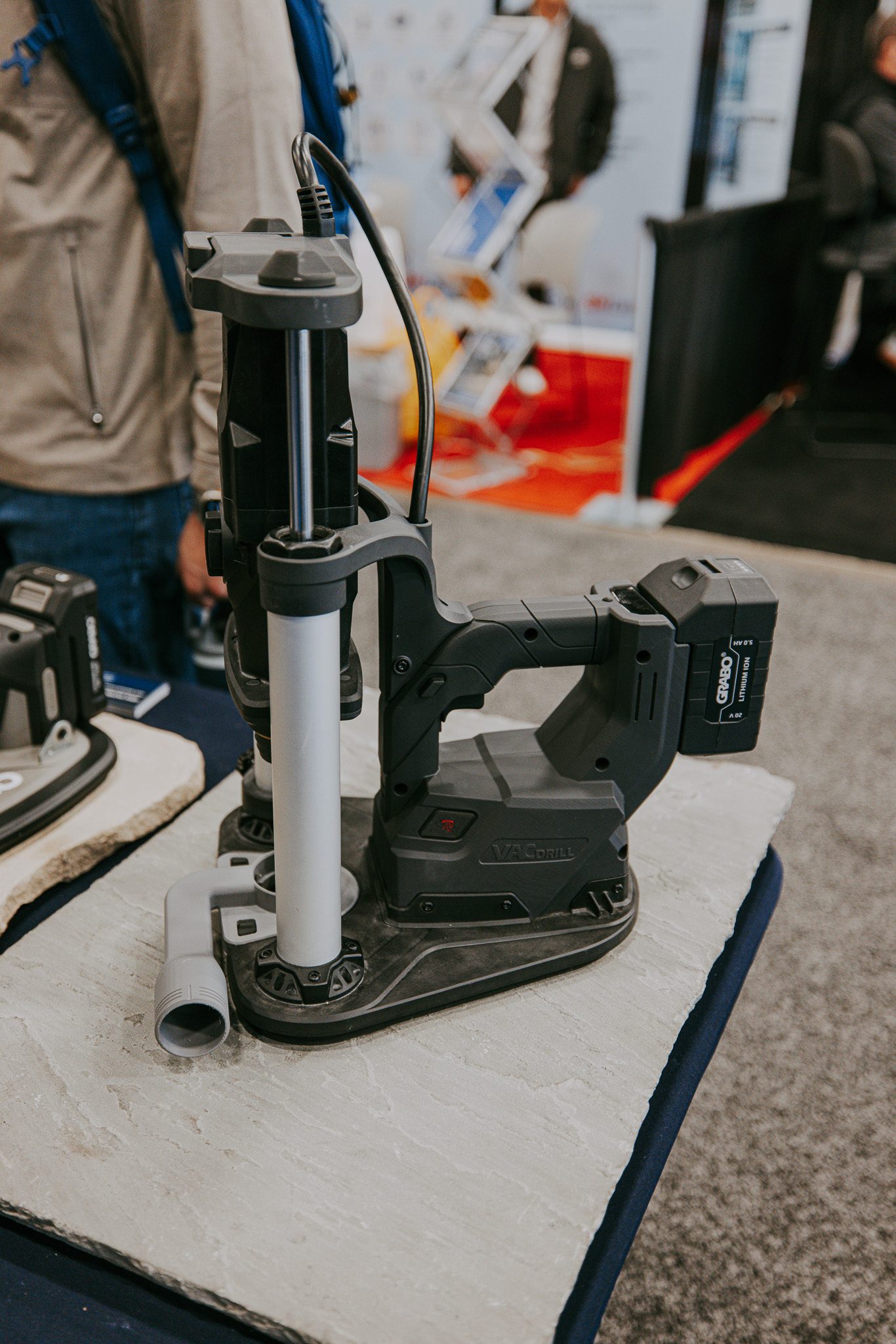
Why hand-held drilling fatigues the operator
A rotary hammer in concrete produces three simultaneous loads on the operator: feed force to keep the bit engaged, torque reaction as the bit bites, and hammer recoil transmitted through the handles. On a vertical wall or overhead, the operator also resists gravity. Hold that for a morning and shoulders, elbows and wrists pay for it.
Feed force requirements rise with bit diameter and concrete strength. A 16 mm bit in C40/50 can demand 80–120 N of steady push, with transient spikes above 200 N when aggregate is struck. Overhead, the operator supplies that force with arms extended — the worst posture for sustained exertion.
The VACDRILL inverts the arrangement: a powered vacuum pad clamps the machine to the surface with up to 45 kgf (≈441 N) of holding force. Feed is supplied by the guided column, not by the operator's body. The person positions, anchors, and supervises.
What 45 kgf actually means
Holding force is the pressure difference across the sealed pad multiplied by the sealed area, limited by ambient atmospheric pressure (≈101 kPa at sea level). VACDRILL's published figure — 45 kgf — is the measured static pull-off on a sealed reference surface, not a theoretical maximum.
On site the achieved force depends on surface finish, porosity and seal quality. A dense, lightly textured concrete slab delivers close to the reference value. A rough, porous block leaks and delivers less — which is why the pump runs continuously to sustain the differential.
441 N exceeds the typical feed and recoil loads by a factor of two to four, which is why the machine can remain clamped while the SDS hammer operates. The safety margin is intentional: the anchor must hold while the hammer tries to break the seal with vibration.
Altitude reduces the ceiling: at 1,600 m ambient pressure is roughly 83 kPa, so the theoretical maximum holding force falls by about 18%. The same machine holds less in the mountains — a detail worth remembering on high-altitude infrastructure work.
Accuracy: a guided column vs a human wrist
A hand-held bit wanders on entry, especially on hard, smooth surfaces. The operator corrects with lateral force, which introduces an angular error that the hole then preserves. The deeper the hole, the larger the positional error at depth.
VACDRILL's column constrains the bit to a single axis normal to the pad. The pad, once sealed, defines the plane; the column defines the angle. The result is a perpendicular hole at the marked position, with the depth stop controlling embedment to within a millimetre — the tolerance adhesive-anchor approvals assume and field drilling often misses.
For anchor patterns — baseplates, rail fixings, strut layouts — the error that matters is not one hole but the pattern. A 2° error in four holes makes the plate miss. A fixed axis removes that systematic error.
Fatigue, vibration and the working day
Hand-arm vibration (HAV) exposure is measured as a daily dose. Conventional hammer drilling is among the highest-vibration tasks on site. A tool that decouples the operator's hands from the hammering (the hands guide feed via a handle, not by bracing the hammer body against recoil) reduces transmitted vibration substantially.
Field observation on repetitive anchor installation shows operators taking micro-breaks to shake out hands — a sign of HAV and grip fatigue. Removing sustained feed force extends productive drilling time and reduces the likelihood of out-of-tolerance holes drilled while fatigued.
The machine does not eliminate HAV exposure — the operator is still present — but it shifts the dominant load from the body to the vacuum pad, which is the ergonomic point.