Drill-Press Accuracy on Site: Why a Guided Column Beats a Steady Hand
A hand-held hole records every tremor. A column records only the axis you set.
Where error comes from
Three geometric errors dominate site-drilled holes: wander on entry, angular error through depth, and ovality from side-load during the cut.
Wander occurs when the bit skates on the hard surface before biting. The operator corrects with lateral force, introducing an angle. That angle projects into a positional error at depth: depth × tan(angle). At 100 mm depth, a 2° error is already 3.5 mm off-target at the bottom.
Ovality comes from steering during the feed — typically the operator compensating for wander or for an uncomfortable stance. A hole that measures round at the surface can be measurably oval at depth, which matters for adhesive annulus and for mechanical anchor bite.
What a guided column changes
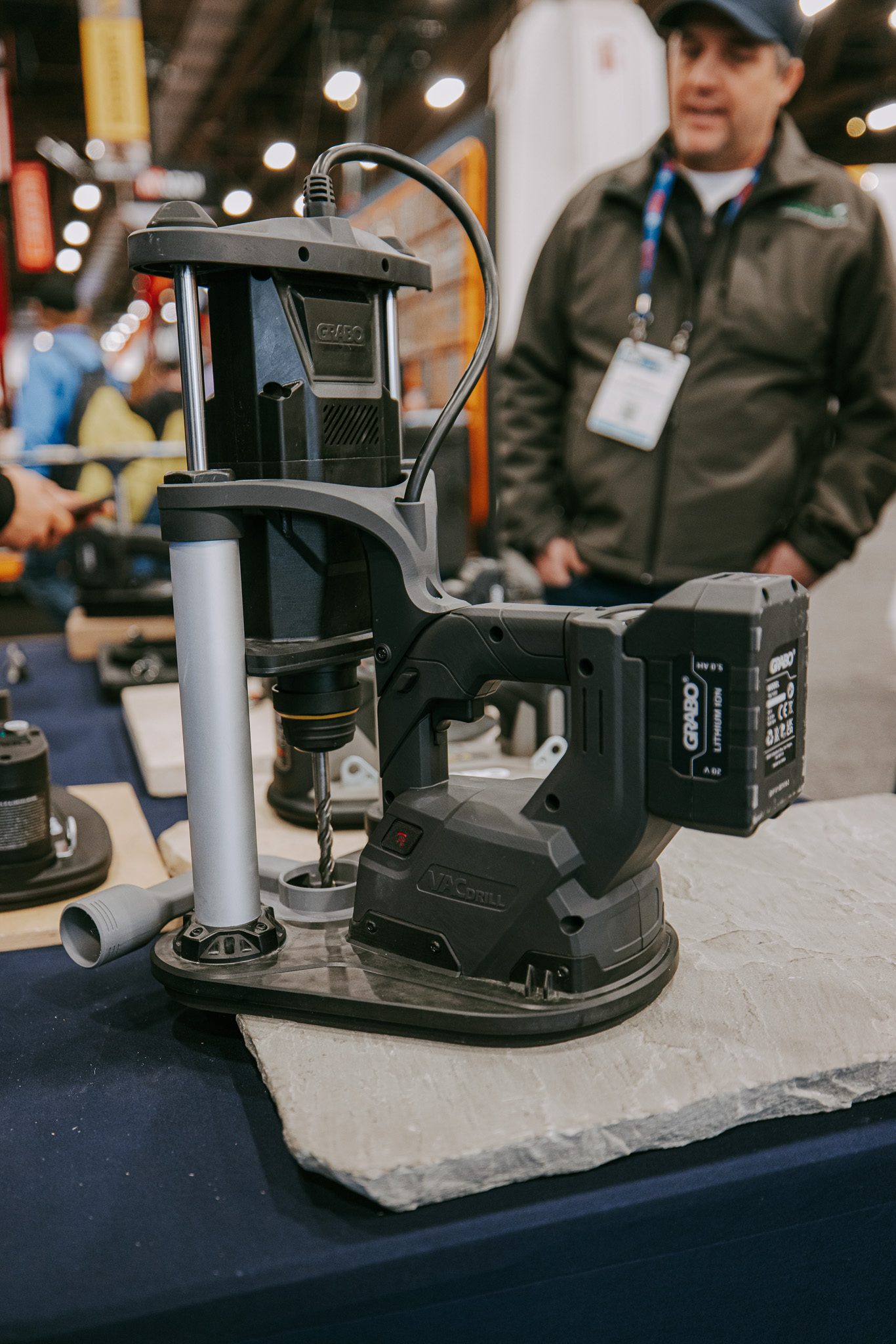
- VACDRILL's column constrains the bit to translation along a single axis normal to the pad. Once the pad seals, that axis is the hole. The operator feeds along the axis; they do not steer it.
- Entry wander is suppressed because the bit contacts the surface already normal to it, with the column resisting lateral skate. The hole starts where marked and remains perpendicular through its length.
- The result is positional accuracy at depth, not just at the surface — the number that determines whether a four-bolt baseplate fits without elongation.
Blowout and rework
- Angular error near the surface reduces edge distance on one side of the hole, inviting breakout and spalling during expansion or under load. A perpendicular hole maximises the concrete cover in all directions.
- Percussive bits exiting a thin element can blow out the far side if fed aggressively. A controlled feed to a depth stop reduces breakthrough violence compared to a hand-driven lunge.
- The cost of an out-of-tolerance hole is rarely the concrete; it is the lost anchor, the extra anchor, the re-design, and the inspection cycle. A guided hole reduces that scrap rate.