Hole accuracy and tolerance
An anchor is only as good as the hole you put it in.
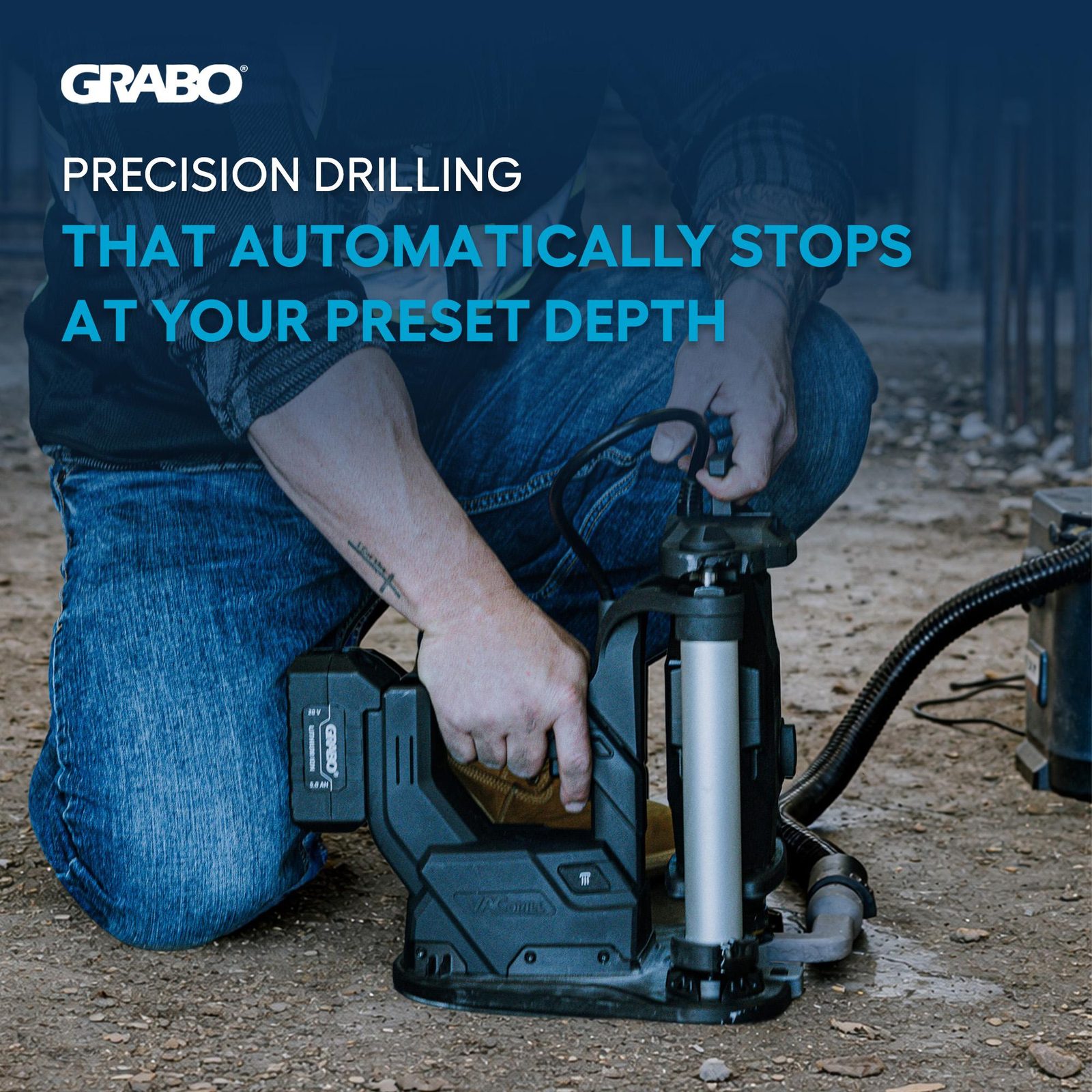
Three tolerances
- Perpendicularity. A hole drilled off-axis reduces effective embedment and loads the anchor eccentrically. A column-guided feed fixes the axis mechanically.
- Diameter. Oversized holes come from a wandering bit, a worn bit, or drilling with excessive side load. Adhesive anchors are especially sensitive to annular gap.
- Depth. Controlled by the depth sensor.
Why freehand drilling drifts
The bit starts in a small crater and is steered by whatever it meets — aggregate, rebar, voids. Freehand, the operator corrects continuously and imperfectly, which enlarges the hole.
Constraining the axis removes the correction loop entirely.
Cleaning is part of tolerance
For adhesive anchors, hole cleaning is as important as hole geometry. Dust left in the hole is a bond breaker; manufacturers specify brush and blow cycles for a reason. Capturing dust during drilling reduces — but does not replace — that cleaning step.
Questions about this
Why does perpendicularity affect anchor capacity?
A hole drilled off-axis has less effective embedment for a given depth and loads the anchor eccentrically rather than axially, so it does not develop its rated capacity.
Does drilling with extraction mean I can skip hole cleaning?
No. Extraction removes most spoil as it is produced, but a fine adhered layer remains on the hole wall. Adhesive anchors still require the manufacturer's brush-and-blow cycle.